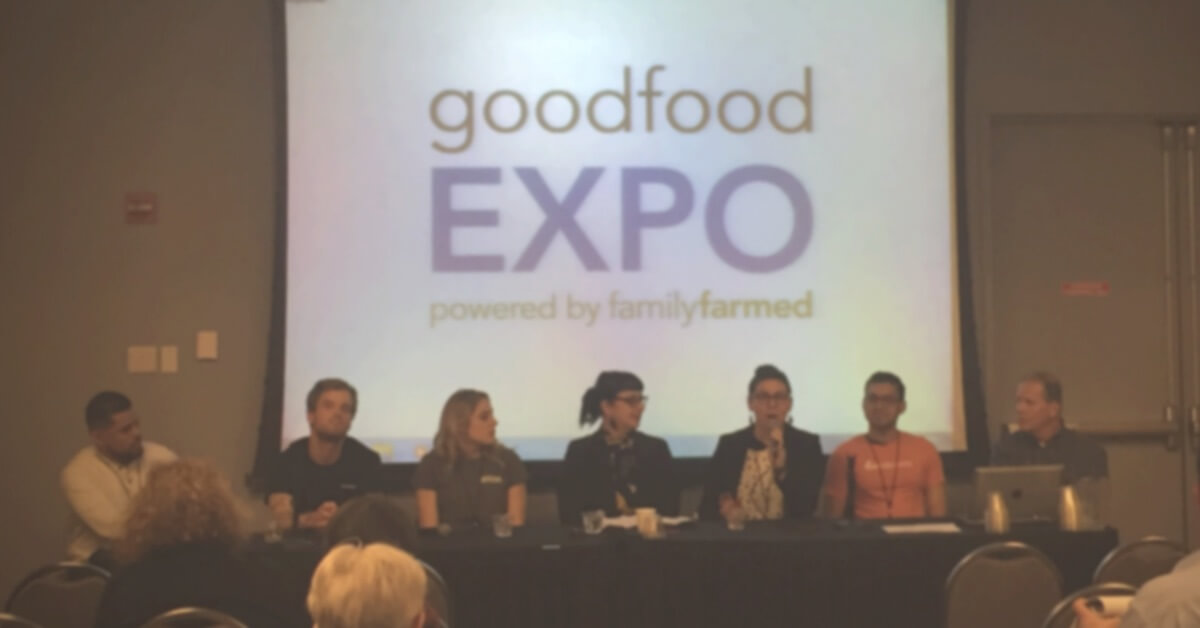
What do you get when you cross a group of farmers, producers, trade buyers, chefs, policy makers, investors and other good food supporters? The Good Food Expo, of course! This annual event in Chicago is focused on bringing together people who are looking to play a role in rising the tide of our food system. It was an energizing way to spend the day; I’m excited to share a few takeaways, and maybe you’ll join me next year?
The day kicked off with a panel1 on the Good Food Purchasing Policy in Chicago, which is working to create a sustainable, socially responsible food system that includes changing the way agencies purchase food, such as buying more local products. It was fantastic and encouraging to hear how their work is not only impacting people in Chicago, but also influencing other cities, particularly in the areas of improving school lunch room options, aviation (i.e. the airports), parks departments, and elderly care programs. (Note: I am writing up a detailed summary for the policy committee at the Milwaukee Food Council, and would be happy to share detailed notes with anyone who is interested.)
The most memorable quote of this session was from Leslie Fowler, the Chief of Nutrition and Facilities Operations, Chicago Public Schools. Leslie quoted her mother who would say, “…a closed mouth doesn’t get fed.” In other words, if you want to see change happen, you’ve got to speak up and do something.
The next general session was on regenerative agriculture featuring a power-packed panel2 of industry experts from companies we’ve all heard of like Organic Valley, Clif, Nature’s Path and Rodale. They shared how important it is for us to set standards for caring for the land while also recognizing that each farm is different and needs to have some autonomy to operate independently.
The panel also talked about whether regenerative agriculture certifications should be consumer-facing messages, or if they are more of a language of the trade. Matthew Dillon from Clif raised the issue of “NASCAR packaging,” which is something we used to talk about in my Kraft days. NASCAR packaging is a nickname for when there are so many claims and bursts on a package that it ends up looking like a NASCAR race car and all messages get lost.
I then headed to a session on Incubators, Accelerators and Shared Kitchens. The panel3 reinforced how wonderful the food community tends to be when it comes time to share ideas, resources, and paying it forward to younger startups.
A few of the key takeaways:
- Have a business plan. This sounds fundamental to many of us, but it is shocking how many people don’t have one. The panelists recommended something between an old school 100-page business plan and a simple 12-page pitch deck. The advice is to separate yourself from your “baby” and look objectively at things like your financials and marketing strategy.
- Have a clearly defined mission, vision and values statement. Again, it sounds obvious. You’d be surprised how many founders don’t the time to document these important strategic pieces.
- Define what success looks like to YOU. It might not be the same as someone down the street – and that’s ok.
- Think ahead about investors. Decide your non-negotiables when you start thinking about investment money. What tenets of your brand are foundational and which are flexible?
- Location, location, location. Consider alternative real estate options in up-and-coming neighborhoods for affordability as well as making an impact on the local economy.
- Cost-sharing. Incubators and similar groups can provide opportunities to share overhead costs and purchase orders, saving you money.
- The big guys are going small. Companies like Kraft Foods, Nestle and Chobani all have their own version of incubators and/or accelerators so they can get in on the action and learn from what these “speed boat-like startups” are doing in the food world.
Next came a session to discuss the new breed of millennial food entrepreneurs. I loved hearing these driven, vision-oriented entrepreneurs talk about their businesses, and not just because they talked so much about building a strong brand! A few key takeaways from this panel4 included:
- Own your point of difference. Know your point of difference…you only have a few seconds to stand out.
- Design matters. It is easier and more affordable than ever to get good design, so everyone is stepping up on packaging design. The bar is high.
- Verbiage shifts. We’re seeing shifts from gluten-free to grain-free, which tends to have fewer negative taste associations. Also, rather than calling out niches like Paleo, brands are focusing on the benefit of it (e.g. low sugar), which has a broader appeal.
- Speed wins. Early on it is all about velocity – rock it at a limited number of locations before you expand.
- Consider alternative strategic partners. Co-packers can be good strategic partners because they can help with inventory and capital.
- Take it slow. Don’t raise too much too early because it sets the stage for unrealistic growth expectations. You need time to learn from consumers and refine products and messaging. Young companies must grind it out at first.
- Think ahead. When speaking to investors, have a plan and know how much you think you’ll need in the end so you can back in to a plan for what you need in each round of funding.
- Local focus is growing. The example was a local retailer changing the name of a position from “Director of Organic” to “Director of Local.” Sourcing is growing in importance to people.
- Know thyself. Before scaling to the next level, create processes to stay true to the core tenets of your brand through operations and culture.
- Love it. You need to live your brand purpose every day. This job is HARD!
Next I went to a session on Social Media Marketing and Ecommerce, and enjoyed listening to one of my former coworkers share her experiences at Simple Mills, along with the other panel members. The panel5 offered the following tips:
- Cross pollinate between online and offline. Online and offline efforts help create efficiency across your marketing plan. It’s ok to repurpose great images and cross promote social media and E-commerce platforms.
- Choose an Amazon partner carefully. Amazon can be a black box, but there’s also no denying it can take your sales to the next level, so choosing a partner to help you navigate is useful. Choose someone who will 1) roll up his or her sleeves and learn about your business as well as teach you, 2) has experience in your industry who can cross pollinate ideas and know what’s resonating in the market, and 3) has Amazon experience to know tricks of the trade like navigating lightening deals.
- Choose internal or external team members based on capabilities. For social media, know what you’re good at, such as content creation, and what you need to hire an expert for, such as technical skills or ads. Provide guidelines to all involved to share the ins and outs of your brand – and your vision to help build it.
- Diversify online beyond Amazon. Some brands send traffic from their site directly to their Amazon site; however, you may want to maintain your own E-commerce platform as well for when glitches happen with Amazon. Other online sites like Thrive, VitaCost and Fresh Direct even assign a person to work with you.
Last but not least, there was a session about getting and keeping your product on the shelf. A few tips from this panel6 of experts from KeHE, UNFI and Whole Foods could make or break a company, especially early on. This panel reinforced the need for a strong brand and strategy as well, which I was happy to hear.
- Think ahead to shelf placement. Know what spot you’d like to fill and what you could replace to show you’ve put some thought into the retail strategy.
- Give them something to talk about. What kind of promotional support will you provide? Going deep four times a year is better than more frequent discounts that are not as meaningful (should be over 10%). Beyond discounts, share your plans for sampling, shelf talkers, social media and more.
- Speedy delivery. Be ready to talk about how you’ll transport your product to the store.
- Go local. Whole Foods likes one key local/regional provider per category.
- UPC changes are bad. Don’t change your UPC! Just don’t.
- Price stability is good. Set pricing structure up front. Know pricing structure before including a distributor or going to Club stores. Pricing changes are challenging.
- Velocity is king. Do not try to grow too fast or act bigger than you are. Make sure you can support the growth as you scale. Velocity per store is more important than distribution points, especially early on.
- Scale volume through foodservice. Pursuing foodservice customers can be a good way to move a lot of product to help you scale as you also build your retail strategy.
- The coolers are full. If you can be shelf stable, go there first. Just because certain categories are increasing in popularity, it doesn’t change the shelf space currently available.
The only downside of attending these great sessions is that I didn’t get as much time as I would have liked walking around the trade show floor talking with food brands of all different sizes and stages. I did get there though, and I met some great natural food company founders with fantastic stories. I will share some of the interesting things brands were doing well to set themselves apart in the next post.
In the meantime, join me at the Real Food Brands Marketing Round Table – a free Facebook Group for natural food entreprenuers (packaged goods and CSA farmers) and select industry experts to make connections, ask questions and share ideas.
If you’d like to see who was on each of these panels:
1 Good Food Purchasing Policy in Chicago
Leslie Fowler, Chief of Nutrition and Facilities operations, Chicago Public Schools
Rodger Cooley, Exec Director, Chicago Food Policy Action Council
Dr. Julie Morita, Commissioner, Chicago Department of Public Health
Fred Lechlitner, Miller Poultry
2 A Discussion of What the Regenerative Agriculture Certification Brings to the Table
Arran Stephens, Founder of Nature’s Path
David R. Montgomery, Professor at the University of Washington, Author
Jeff Tkach, Rodale Institute
Matthew Dillion, Clif Bar
Theresa Marquez, Organic Valley
3 Incubating Good Food: Food Business Incubators and Shared Kitchens
John Richards, CEO Kishr Tea and Co-Founder Dream Kitchens
Kevin Echevarria, Co-founder & CEO Dream HUB
Natalie Shmulik, CEO, The Hatchery Chicago
Nick Devane, CEO, Pilotworks
Kelly Reinke, Kraft Springboard
Jordan Buckner, CEO, Co-founder TeaSquares
Rebecca Frabizio, Dir of Entrepreneurial Programs Family Farmed/Good Food Accelerator
4 The Good Food Entrepreneur
Alan Reed, Exec Dir, Chicagoland Food & Beverage Network
Luke Saunders, CEO, Farmer’s Fridge
Megan Klein, President, Here
Steve Gather, President JB Chicago and Partner Spiral Sun Ventures
5 Social Media Marketing and Online Sales
Elizabeth Crawford, Sr Correspondent, Food Navigator
Michelle Beels Lorge, VP of Marketing, Simple Mills
Kara Buffardi, CEO & Founder, Craveity Marketing
Ryan Flynn, CEO & Founder, Charmac Solutions
6 Getting Your Product On Shelf
Kathy Nyquist, Principal, New Venture Advisors
Laura McCord, Exec Director, Category Mgmt, KeHE Distributors
Kimberly Bentz, Supplier Support Group Manager, UNFI
Julie Blubaugh, Marketing and Community Relations Specialist, Whole Foods
Seth Bender, Partner, Savor
Kelly Cosgrove, New Business Development Director, Fortune Fish & Gourmet
 Katie has 15+ years of experience in brand management and marketing across a range of popular brands from Fortune 500 consumer package goods companies to local startups. She has degrees in Marketing & Management from the University of Wisconsin – Madison School of Business and now, as an independent consultant, she is dedicated to helping local and natural food brands become category leaders in both philosophy and growth.
