Sometimes you get a brilliant, game-changing idea and the best thing is to get it to market as quickly as possible. The problem is that it’s not as easy as coming up with a great recipe in your kitchen and then immediately scaling it. You need to source commercial ingredients, work around suppliers’ and co-packers’ limitations, and make sure you have the certifications your brand needs to reflect your values.
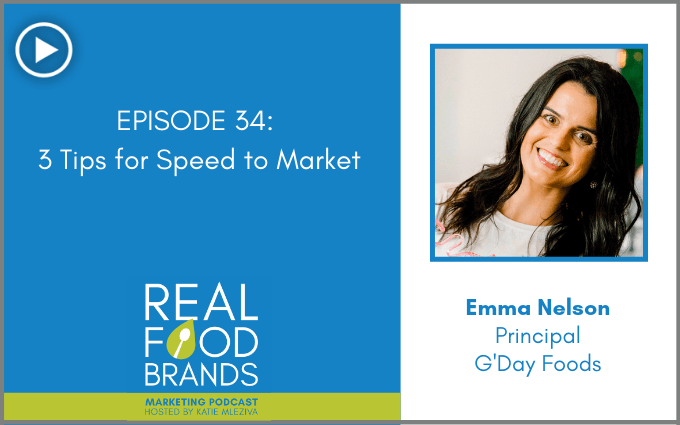
Today on the Real Food Brands Podcast, host and Brand Strategist Katie Mleziva talks with Emma Nelson, Principal at G’Day Foods. She uses her expertise in commercial development to help brands make their products work at scale.
The Ins and Outs of Taking Products to Market Faster
“During my time both in college and even in high school, I considered myself a lab rat,” Emma says. “I really loved it, but what I realized I wanted from my future and my future career was really this connection between biochemistry and the outside world.” She quickly found her answer in the food and beverage industry, getting a Masters in Food Science. After ten years of working in product development, she started G’Day Foods to share the knowledge she’s learned.
“A lot of food and beverage entrepreneurs and businesses don’t really have their foundation grounded in food science,” Emma says, so one of her biggest focuses has been commercializing new products and getting them to market faster. The focus of this episode is on three tips she has to achieve that goal. “The differentiating factor in how you utilize these tips,” she says, “is really how quickly you’re going to be able to move through the process.”
1. Have a Finalized Formula with Commercially Available Ingredients
“With a trusted vendor network to fuel that finalized formula, you can hit ‘go’ that much faster,” Emma says. Most brands that she works with have a “gold standard” formula that they want to bring to market, but sometimes either that formula or the ingredients sourced for it aren’t commercially viable. If you’re having trouble you can work with a formulator like Lindsay Wisener to find the right balance between delivering a product you love that can also scale. The bulk of Emma’s work is helping formulators find the right vendors while guiding the product development process to meet expectations.
Evaluating the effectiveness of commercially viable recipes means being thorough about all of the things a consumer might notice about the product. Does it melt the same? Does it look the same? Does it taste the same? This helps your formulator (and someone on the commercialization side, like Emma) because it gives them concrete goals to hit as they consider potential recipes.
“In order to evaluate a supplier for commercial scale, you need to take the time to understand their minimum order quantities and the rational for those order quantities,” Emma says. You also need to look their third-party certifications, any information they can provide for labeling, and their ability to provide nutritional information. “Ultimately, it’s up to the brand to really dig into their ingredients and their ingredient-suppliers.”
2. Understand Both Your Co-Manufacturer’s and Suppliers’ Timelines
If you’re trying to do something quickly, whether it’s get to market, do a brand renovation, or add a new flavor, timelines can creep up on you. Regardless of everything else you need to do, whether it’s marketing or design, the bottom line is you need to actually get your product on the shelves.
“Look at what suppliers you can push,” Emma says, “you have to have those conversations before every production run to understand if you can push them or if, in this particular situation, their timelines are pretty stringent.” Some suppliers have an option to expedite, which can be costly but can be worth it to get to market faster. On the other hand, don’t assume that it’s always an option—check before you wind up between a rock and a hard place. “Vendors are meant to be some of your best friends in the business,” Emma says, “you call them in good times, you talk to them in bad times, you ask for favors when you desperately need them, and you give back when you have the opportunity.”
3. Know Where You Can Make Concessions
“You can’t be everything to everybody,” Emma says, “and you can’t deliver all the time on every value that everybody wants to see come out of your product. When you’re able to define those pieces of your brand DNA upfront, they’re really going to serve as the framework, through your commercialization process, of what you can concede on.” If you’re trying to get to market quickly, you need to have an understanding of what is actually key to your brand and what you don’t need to wait for.
Depending on your product, some food and beverage certifications can take as long as six months. Laying out a commercialization timeline can help you understand where you’re going to run into problems and make those decisions ahead of time. There are a lot of factors like supply chain, warehousing, and more that you need to consider. At the end of the day, it’s all about knowing what your must-haves are based on your brand strategy, and what is more in the realm of nice-to-have.
Please join us by listening to the podcast for more in-depth information on natural food and beverage business new product commercialization, and don’t forget to subscribe on your favorite podcast player so you never miss an episode.
Now, let’s go shake up shopping carts!
In This Episode:
- How Emma got into the food industry.
- Her three biggest tips for getting a product to market more quickly.
- What makes for commercially available ingredients.
- Why you need a “gold standard” formula.
- The importance of understanding your co-manufacturer’s and suppliers’ timelines.
- Why working with suppliers is a give-and-take relationship.
- Why it’s so important to know where you can make concessions with your formula.
- The factors you might not consider when you make a go-to-market timeline.
Quotes:
“In order to evaluate a supplier for commercial scale, you need to take the time to understand their minimum order quantities and the rational for those order quantities.” – Emma Nelson
“When you’re able to define those pieces of your brand DNA upfront, they’re really going to serve as the framework, through your commercialization process, of what you can concede on.” – Emma Nelson
“Vendors are meant to be some of your best friends in the business. You call them in good times, you talk to them in bad times, you ask for favors when you desperately need them, and you give back when you have the opportunity.” – Emma Nelson
“A product that solves a problem for somebody is going to be a product that they’re going to continually want to use and integrate into their life.” – Emma Nelson
Resources: