Building a relationship with grocery retailers is about more than just making a great product they can put on their shelf. You need to have a real understanding of who your consumer is, what else they put in their shopping carts, and why your food or beverage brand provides value to a store beyond the profit margin on an individual sale.
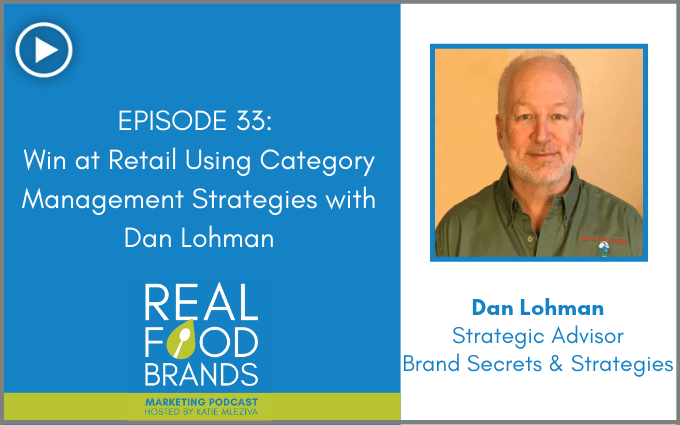
Today on the Real Food Brands Podcast, host and Brand Strategist Katie Mleziva talks with Dan Lohman, a CPG and Natural and Organic Industries Strategic Adviser. His company, Brand Secrets and Strategies, helps provide brands with actionable insights and strategic solutions to get on more store shelves and into the hands of more shoppers. He’s also the host of the Brand Secrets and Strategies Podcast.
What Is Category Management?
“In Natural, when I tell people I’m a category management expert, they think, ‘Oh, you’re the guy that draws the pretty picture,’ (referring to the planogram) or, ‘you’re the guy that puts the product on the shelf, etc.,” but no. Category management is the art and the science of getting your product into the hands of the end consumer,” Dan says.
The idea of category management was developed in 1992 in order to weed out the inefficiencies in the consumer product goods (CPG) system. “What spurred that change was a little retailer called ‘Walmart,’ which forced everyone to be more strategic,” he says, “instead of focusing on how much product you can push through a store, it became about how much product you can push through a store and make a reasonable profit, so we started focusing on contribution.”
Flash forward to today, and some retailers will only work with Certified Professional Category Managers (CPCM). “A lot of the big brands get siloed—they don’t think about how their project is interacting with other projects throughout the store and they rely heavily on what I call ‘push-button category management,’” Dan says, “true category management focuses on how your product interacts with the consumer that buys it.”
Focus on Market Basket
“What I try to do is teach brands to focus on market basket,” Dan says, “the sum total of all the dollars you spend as you leave the retail store.” If you’re an organic brand, for example, then your shopper is more likely to buy other organic products throughout the store. “By focusing on the market basket and then working backwards to see how your product interacts with other products and categories in the store, you’re better able to help the retailer compete more effectively in their market.”
When you’re getting in front of retailers, focusing on your brand story is key. You need to answer some keys questions: What does my core consumer look like? What makes them unique? What makes my consumer different, better, etc., than my competitor’s consumer? This information equips you to educate the retailer on your unique consumer so you can prove to them how your brand will drive traffic and sales to their store.
How to Build Relationships That Build Brands
“A lot of mainstream retailers and brands spend all their time trying to reacquire the same customer,” Dan says, “instead of trying to reacquire them, it’s about building a relationship with that customer where they’re your greatest asset, and you can leverage that relationship to help drive sales and compete more effectively.” That relationship can help you show your value to retailers by making their job easier, which can give you access to data and other tools to keep building your brand. Dan has lots of great, specific advice about keeping your product in stock, how to leverage data and more, so listen to the full episode for all of his amazing insights.
Please join us by listening to the podcast for more in-depth information on natural food and beverage business category management, and don’t forget to subscribe on your favorite podcast player so you never miss an episode.
Now, let’s go shake up shopping carts!
In This Episode:
- Why category management is so important for developing deeper relationships with retailers.
- What most people get wrong about category management.
- How to focus on market basket to help grow your retailer partners’ total sales.
- The questions you need to ask to develop your brand story.
- What retailers want to see to justify stocking your product.
- Why you don’t want to have to keep reacquiring the same customer.
- Why issues at the store ultimately reflect on your brand, not the retailer.
- How to get data and what to do with it.
- What Dan did when a competitor showed up with a big check to get his product off the shelves.
Quotes:
“Category management is the art and the science of getting your product into the hands of the end consumer.” – Dan Lohman
“True category management focuses on how your product interacts with the consumer that buys it.” – Dan Lohman
“By focusing on the market basket and then working backwards to see how your product interacts with other products and categories in the store, you’re better able to help the retailer compete more effectively in their market.” – Dan Lohman
“A lot of mainstream retailers and brands spend all their time trying to reacquire the same customer. Instead of trying to reacquire them, it’s about building a relationship with that customer where they’re your greatest asset, and you can leverage that relationship to help drive sales and compete more effectively.” – Dan Lohman
Resources:
- Take a Course with Dan (If you enjoyed the podcast, please this unique affiliate link for Dan’s courses!)
- Brand Secrets and Strategies
- The Brand Secrets and Strategies Podcast
- Secrets 115: SUCCESS = Brand Strategy + Execution With Michael J. O’Donnell From The Belmullet Food and Beverage Group
- Real Food Brands Marketing Roundtable Facebook Group
- Real Food Brands website (download your Brand Checkup Scorecard here)