There’s an old saying that if Henry Ford would’ve asked people what they wanted, they would’ve said, “A faster horse.” Being a challenger brand in an established food category means you need to be willing to shake up the status quo and take the risks that bigger brands won’t.
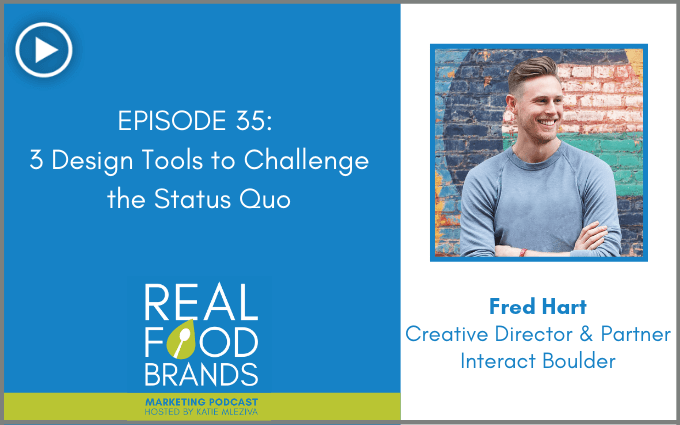
Today on the Real Food Brands Podcast, host and Brand Strategist Katie Mleziva talks with Fred Hart, Creative Director and Partner at Interact Boulder, an entrepreneurial branding and packaging design agency obsessed with the food and beverage industry. We talk about what you can do to stand out as a small to mid-sized food brand, and the three design tips Fred has to differentiate yourself on shelves as well as examples of brands that have done it.
Getting Everything in Alignment
Fred started out as a graphic designer in San Francisco and happened to work with some food and beverage clients. As he dove into the work, he was struck by the large number of people his age that were starting new food companies and wanted to get involved in changing what we eat and where it comes from. “It’s definitely about surrounding yourself with like-minded people,” Fred says, “we try to hone that in terms of the agency, and for us, that means associating with the food and beverage industry more so as a an organization and a company than we do with the branding and advertising world.”
This unique approach to marketing the industry makes a big difference when they sit down with a client for the first time. “We’re not talking to them just about their branding and packaging which is a bright and shiny star,” Fred says, “but all of the other million of stars that they have to align in order to find success.” Everything from co-packagers to food scientists to regulatory lawyers comes into play. When it comes to supporting “challenger” brands, getting a handle on everything that needs to happen from the start can make a big difference.
Challenge the Category, Not the Consumer
“There are only so many brands that are at the top, the one, two, and three spots that make the rest of us challengers,” Fred says, “but when it comes to what we’re actually putting inside our bodies that conversation has changed dramatically.” Interact Boulder works with these companies to turn the status quo on its head and change our relationship to food. Overall, their agency mantra is to “challenge the category, not the consumer.”
“For us, the opposite of bravery is not cowardice but conformity, and what the world doesn’t need is another ‘me too’ brand,” Fred says. A good example is BOOMCHICKAPOP. The category at the time was mostly bags of popcorn that showed popped popcorn. “What we would ask at the time was how many consumers don’t know what popped popcorn looks like?” The thing they realized is that a consumer doesn’t need to see popcorn to know that it’s popcorn, especially when you’re shelved around other competitors. Instead, they went with a big, bold name, an eye-catching color palette, and were really able to play up personality and brand characteristics in a way that was unique to the category. “For us, it’s this delicate balance of help people make decisions but also stand out,” Fred says, “it’s too easy to just be different for difference’s sake.”
The 3 Design Tools Challenger Brands Have
In working with food and beverage brands that are looking to scale, Fred and Interact Boulder like to point out that they have an ability to take risks that bigger companies don’t. That’s not just in terms of product, but also packaging and design. “We like to say that people don’t read, they recognize, yet so many of the food and beverage brands are predicated on reading them,” he says. They try to work with smaller brands to take small but calculated risks with brand marks to build that recognition.
From a design lens, Fred identifies three tools you can use to challenge the status quo. One is the structure of your packaging, and Fred points to Boxed Water as an example of this. The second brand asset you can look to is color—think of the yellow yerba mate brand Guayakí uses or the purple of Sambazon Açaí. The third is imagery: “we believe the best brands don’t force people to read but promote recognition,” Fred says. Something like Monster Energy or the Starbucks mermaid are good examples of this. At the end of the day, recognition is pretty simple: if you were to tell someone to go out and buy that product, how would you tell them to identify it?
Please join us by listening to the podcast for more in-depth information on challenging the category you play in within the world of food and beverage, and don’t forget to subscribe on your favorite podcast player so you never miss an episode.
Now, let’s go shake up shopping carts!
In This Episode:
- Why brands need to think about more than just branding and packaging from the get-go.
- How to challenge the category, not the consumer.
- What BOOMCHICKAPOP did to stand out in a crowded category.
- The dangers of being different for difference’s sake.
- Why people don’t read, they recognize.
- How Boxed Water used packaging to differentiate themselves.
- How to take advantage of color to stand out.
- Why imagery is key to recognition.
Quotes:
“When we have that first meeting with a brand, we’re not talking to them just about their branding and packaging, which is a bright and shiny star, but all of the other million of stars that they have to align in order to find success.” – Fred Hart
“Our mantra is to challenge the category, not the consumer.” – Fred Hart
“For us, it’s this delicate balance of help people make decisions but also stand out. It’s too easy to just be different for difference’s sake.” – Fred Hart
“We like to say that people don’t read, they recognize, yet so many of the food and beverage brands are predicated on reading them.” – Fred Hart
Resources: