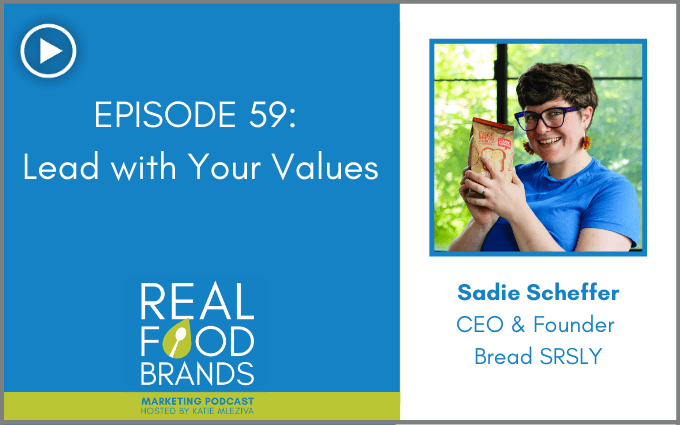
Whether you lead a team of one or one hundred, it’s critical to think about your role as a leader and how you’re going to lead based on your values. For our guest today, that comes down to having the courage to acknowledge past mistakes and use them to learn and grow.
Today on the Real Food Brands Podcast, host and Food & Bev Brand Strategist Katie Mleziva talks to Sadie Scheffer, CEO and Founder of Bread SRSLY, a gluten-free vegan sourdough bread company based in Berkeley, CA. In this episode, we talk about how Sadie leads through shared values, and the big lesson she learned about how her team can grow faster by learning together.
Why Leadership Comes Down to Shared Values
Sadie started out as a Mechanical Engineering major at MIT, but dropped out and moved to San Francisco to pursue her crush. He had recently gone gluten-free, so she decided to devote herself to gluten-free baking and cooking to get his attention. For ten months she invited him over for dinner to taste her progress and, long story short, they got married in 2016. Along the way, Sadie developed an obsession for delicious gluten-free baking that would lead her to found Bread SRSLY.
Through it all, Sadie has been able to steer Bread SRSLY from a passion into a successful brand through the strength of her leadership. “I think of leadership first as who I am as a leader, not as where I’m steering as a company,” she says, “you need to be clear on your personal values, as a leader, and your company values and be true to both of them.” This is all the more important in uncertain times like now, where you need to stay true to your values and use them as decision-making tools that will help them shine through.
How Bread SRSLY Defines Their Values
“I didn’t always think of myself as a leader: I didn’t call myself the CEO until about two years ago,” Sadie says, “I didn’t realize that other people thought differently than I do, I didn’t understand my own weaknesses, I didn’t understand how to compensate for those weaknesses, and it took so much mountain climbing to get over the hump and step into this role.” Once she realized what her team needed from her, she worked with a food business consultant for six months to become a better leader. “Instead of just thinking of myself as not a leader, I understood that I could do something about it,” she says.
“Every leader goes through this, there’s always struggles,” Katie says, “whether your sales are soaring and your team is flying high, or you’re struggling in some way, it’s never easy to be a leader.” For Sadie, when she first set out to define her values she wrote them primarily for her customers to see. “I didn’t have a lot of conviction behind it, and there were like fifteen of them,” she says, “how could I possibly hold myself accountable or be held accountable to all fifteen of them?”
When Bread SRSLY got serious about leadership and came back to it, they simplified everything to a simple mission statement: “we’re serious about reuniting people with sourdough when they thought good bread was off the table.” It puts words to the feeling they all have when they’re at a trade show, give someone a sample, and see the look on their face when they realize they can eat sourdough again. Recently, Sadie’s been trying to make Bread SRSLY’s values more actionable by stating them as verbs: to serve, to nourish, to include, and to revive. They then break that down for how each applies to their customers, to their employees, to their community, and to their products.
Why You Need to Let Your Team Make Their Own Mistakes
For Sadie, keeping her team aligned means connecting with everyone on her team as people, first. “I think culture comes down to behaviors,” she says, “it’s whether someone thinks that they’ll be respected or not when they walk through the front door, it’s whether someone leaves feeling fulfilled and happy, or feeling stressed and bringing work home with them.” All of this requires leadership to model them and teach them, and actively work to change things for the better.
One big thing Sadie does at Bread SRSLY is to encourage people to make mistakes, but only if they can learn from them. “It is so hard to watch someone else make a mistake that you’ve already learned the lesson from,” she says, “but I realized I was taking away my team’s opportunity to learn important lessons by just telling them the lesson.” She liked the feeling of jumping in and solving problems but needed some self-reflection to realize that sometimes the best course of action was giving her team the chance to learn for themselves. “It’s rewarding to see people step into their roles and their own leadership, and it’s very humbling to realize that I was the reason they couldn’t do that,” she says.
“With me stepping in and solving problems, our company is only going to grow as fast as I can grow, but with 26 people stepping in and solving problems, our company is going to grow 26 times faster,” Sadie says.
Listen to the full episode for more, including how a book club is helping the entire Bread SRSLY team grow into leaders.
Now, let’s go shake up shopping carts!
In This Episode:
- How a crush led Sadie to drop out of MIT and get into gluten-free baking.
- Why leadership starts with who you are and what values you have – for yourself and your business.
- How Sadie thinks of company culture.
- The values statements Bread SRSLY uses to keep aligned and why they are all verbs.
- Why Sadie encourages her team to make mistakes.
- What Sadie realized about her own leadership style that was getting in the way of her team’s growth.
- How being a confident leader helped Sadie step onto multiple Pitch Slam stages in the past few years.
Quotes:
“I didn’t realize that other people thought differently than I do, I didn’t understand my own weaknesses, I didn’t understand how to compensate for those weaknesses, and it took so much mountain climbing to get over the hump and step into this role.” – Sadie Scheffer
“Every leader goes through this, there are always struggles, whether your sales are soaring and your team is flying high, or you’re struggling in some way…it’s never easy to be a leader.” – Katie Mleziva
“It is so hard to watch someone else make a mistake that you’ve already learned the lesson from, but I realized I was taking away my team’s opportunity to learn important lessons by just telling them the lesson.” – Sadie Scheffer
“With me stepping in and solving problems, our company is only going to grow as fast as I can grow, but with 26 people stepping in and solving problems, our company is going to grow 26 times faster.” – Sadie Scheffer
Resources: