If you’ve listened to the Real Food Brands Marketing Podcast, you’ve heard me say that branding is more than your logo. Along that same line of thinking, marketing is more than advertising and promotions. In fact, at many large consumer package goods companies, the Marketing team runs the business and owns the P&L management.
For those of you who may not be as familiar with this type of organizational structure, this specialty of Marketing is called Brand Management.
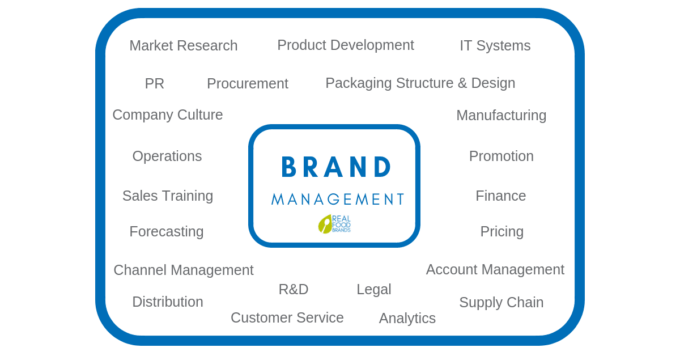
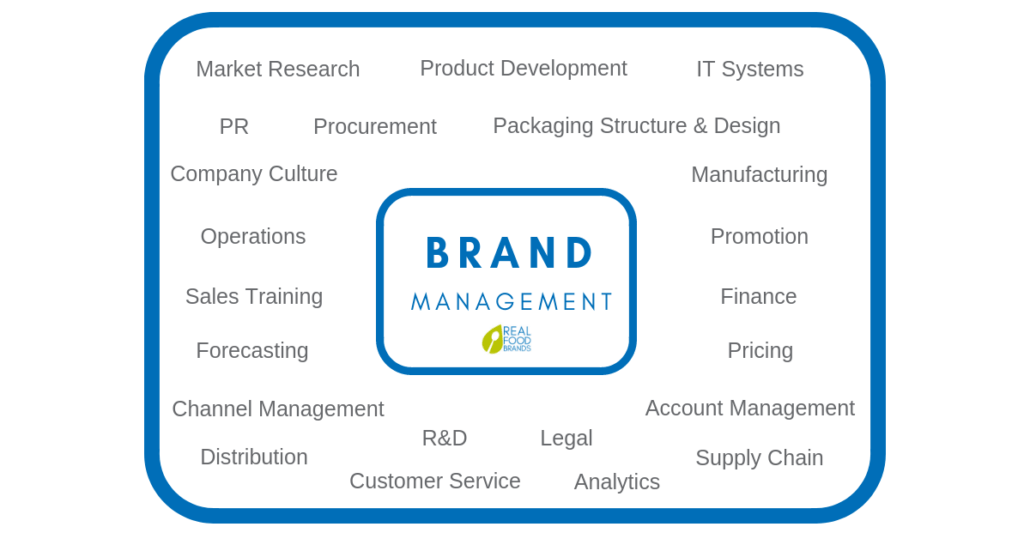
You can think of the Brand Manager at a large food company as the general business manager who works with the various cross-functional team experts. At a smaller food company, the business owner is likely serving as the brand manager, at least in the early days. Many of these cross-functional team “hats” may be worn by just a few people within your team, including employees, contractors and external suppliers.
No matter what size your business is, you have partners and stakeholders you work with, and by adopting a Brand Management approach you will keep your ideal consumers and their needs at the core of all you do. The goal is to make sure that all areas of the business integrate with your vision, goals and consumer needs, so you rally your team to deliver on your promises in a way that is unique to your brand.
You’ll know you’re thinking like a brand manager when you see every function in your business, every team member, and every external partner as an opportunity to organize your brand around your customers’ needs to build value over time.
A Story
To help bring this Brand Management idea to life, I have a quick story. It was from my first interview with Kraft recruiters and although you know how the story ends and that I got the job, I still want to share the lesson.
There were two of them and one of me…they asked this simple, yet loaded question:
“You are the Brand Manager of Oscar Mayer Hotdogs and you get a frantic call that your hotdogs in California are molding and need to be pulled off the shelf. Why is this happening?”
The reason I love this question is because although I had no prior food company experience, I did have the ability to think broadly and connect the dots of my marketing experience so I could think quickly with that general management hat on.
I suggested that maybe a recent price increase could have slowed down velocities on shelf. The team could have recently changed the product formula or packaging design. The refrigerated distribution truck may have lost power to the cooler on the way to the store from the distribution center. Maybe a competitor was promoting heavily for an extended time? Or maybe that demand for hotdogs in California was at an all-time low given the focus on healthy foods…
While challenging, I had never had so much fun in an interview! This is exactly the kind of thinking we used daily in our Brand Managment teams at Kraft, so it’s a good thing I love digging in and solving problems and creating opportunities in real life, too! I’m sure every one of you leading a food or beverage business can relate to this type of scenario.
Taking Action
I like to talk about taking Brand Management approach in two stages: (1) Define or Refine and (2) Align and Activate
The first step is to define your brand strategy, including understanding the market landscape, your competitive set, your ideal audience, positioning, brand personality, and so on. I have a podcast episode about How to Start Building and Documenting Your Brand (Ep #2) if you’d like to dig in further to the topic of defining or refining your brand strategy. While the brand essence of your business won’t change often, it’s good to review your strategy and refine it at least annually to make sure you are still integrating your efforts and motivating your team around a strategy that still meets the needs of your consumers.
The second step is to align and activate. I say align because we need to integrate the brand across all areas of the business; and I say activate because we need to actually implement the initiatives that will help bring the brand to life.
Again, I’m not just talking about your logo and package design. While both of those things should certainly align with your brand strategy, and it’s a good start, your brand strategy serves as the north star for business decisions as you and your team wear all the hats. To think about how to activate your strategy within your business, check out this post on How to Create a 6-Step Marketing Plan to Align Tactics with Business Objectives.
With this approach to Marketing in mind, let’s talk about ways to activate your strategy by aligning your business around your brand.
As I mentioned earlier, you Brand Strategy is your north star, allowing you to rally your stakeholders – consumers, company employees, buyers, suppliers, influencers and investors – all around a common mission.
This is the most critical piece. If you remember nothing else, I want you to think about the importance of sharing your vision and strategy with your team – both internal and external team members – in order to have the smart people you’ve brought on this journey with you to help you deliver on that vision.
For example, say you have packaging that you wish was more sustainable. A packaging supplier may have the perfect eco-friendly version of the food package you are currently using, but you didn’t think existed or was within your price range. If your partners know your goals, they can be more proactive in helping you get where you want to go.
I call this the Align and Activate Phase because it’s about getting your team on board with your vision to align initiatives across the business. You want to look at everything as opportunity, including R&D, promotions, product development, operations, sales, and every other part of your business.
So, what happens if you don’t create a brand strategy and align your business activities around it?
It may not be obvious at first, but over time your lack of alignment starts to confuse your consumer, or worse, frustrate them. And your partners can’t help you achieve your goals if they don’t have a clear vision for where you are going.
If you don’t have a well-defined brand strategy, at a very minimum, think about your positioning statement so you document your 1) ideal audience, 2) category in which you compete, 3) unique point of difference or how you solve the consumer’s pain point, and 4) reason they should believe you.
I created a PDF you can reference to help you with your positioning statement over in the Real Food Brands Facebook group. You can find it under the Files section in the group. Then, use that document to share your vision with your team.
Remember, share some form of your brand strategy with ALL of your partners and suppliers so they can also connect with your brand on a personal level and give 100% effort toward growing your brand as part of your team! You want to surround yourself with people who are just as energized and excited as you are to make your vision a reality.
Now, let’s go shake up shopping carts!
 Katie Mleziva has 15+ years of experience in brand management and marketing across a range of popular brands, from Fortune 500 consumer package goods companies to local startups. She has degrees in Marketing and Management from University of Wisconsin – Madison School of Business and now, as an independent consultant, she is dedicated to helping local and natural food brands become category leaders in both philosophy and growth.