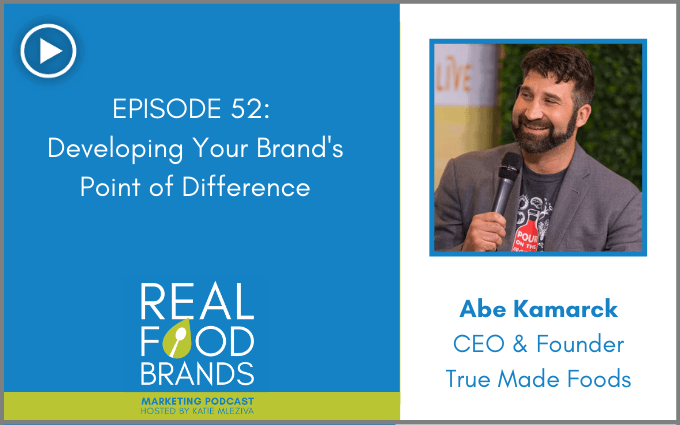
Creating your point of difference can be a big challenge, especially in a crowded category. Our guest today has been able to do that and more, growing a product in an incredibly popular category into a brand with national distribution.
Today on the Real Food Brands Podcast, host and Brand Strategist Katie Mleziva sits down with Abe Kamarck, CEO and Founder of True Made Foods. In this episode, we talk about how he’s been able to get his all-natural ketchup product to a point where national brands are taking notice.
How True Made Foods Was Born
“We make a healthy ketchup, a line of barbeque sauces, and sriracha,” Abe says, “but we cut the sugar and we add vegetables instead.” As a dad himself, Abe knows the feeling of watching his kids put ketchup on everything, so he set out to create a product he knew he could stand behind. As he says, all of his products are tested by 5-year-olds, the most honest taste testers out there.
“Early on, we didn’t advertise the vegetables on the label and that was a big mistake. It cost us a lot,” Abe says, “we had very simple, clean, nice-looking labels that didn’t tell why we were different.” If you’re trying to disrupt your category, you have to find a way to emphasize your point of difference in a way that consumers can instantly connect with. “You have to say why you’re different, upfront,” he says, “the person who’s looking for the same thing isn’t going to buy you or try you for the first time no matter what.”
Competing in a Crowded Category on a National Scale
“Everything’s changing, and what worked five or ten years ago doesn’t work today anymore,” Abe says, “the market’s always changing, the retailers are changing constantly, they’re changing their strategies constantly, so the idea of going into your local Whole Foods and building out from there has really gone by the wayside unless you have the skill to launch nationally first.” Abe suggests that you need to be omnichannel, and possibly launching online first to test out the product if it’s good a fit for online sales.
For Abe, the big difference here is finding a way to launch regionally so you are able to visit all the stores and actually talk to customers yourself. That involved a lot of driving so he could set up his displays himself. As Abe continued to develop those relationships, he found that buyers started reaching out to him, including Walmart. Going national can be expensive for a small brand, “if you’re trying to ship cases here and there all over the country to all these Walmart DCs it can be really hard and expensive,” Abe says, “but there are a lot of consolidators you can get with who will just throw a few of your cases on the back of a truck that is going to Walmart every day for a fraction of the cost.”
There’s a lot more in this episode about what to do when the big brands start copying you, and how to make sure you’re ready for a national launch so be sure to listen in.
To wrap up the show Katie shares that her 12-week RFB Round Table Mastermind group for Food & Bev company founders will be starting again in late Q1. Check out details here or sign up for her email list so you don’t miss out on the details.
Now, let’s go shake up shopping carts!
In This Episode:
- How Abe’s Italian background helped inspire True Made Foods.
- Why he decided to create healthy ketchup, barbeque sauce, and sriracha.
- Why 5-year-olds can be the best taste testers.
- The mistakes he made along the way.
- Why emphasizing your point of difference is so important.
- The difference between ketchup and other categories.
- How Abe grew True Made Foods into a nationally distributed product.
Quotes:
“We make a healthy ketchup, a line of barbeque sauces, and sriracha, but we cut the sugar and we add vegetables instead.” – Abe Kamarck
“Early on, we didn’t advertise the vegetables on the label and that was a big mistake. It cost us a lot. We had very simple, clean, nice-looking labels that didn’t tell why we were different.” – Abe Kamarck
“The market’s always changing. The retailers are changing constantly and they’re changing their strategies constantly, so the idea of going into your local Whole Foods and building out from there has really gone by the wayside unless you have the skill to launch nationally first.” – Abe Kamarck
“Our capability to innovate and move quickly on new products is key. You can’t settle back on your product. You have to always be thinking ahead to make them better.” – Abe Kamarck
Resources: