Influencer marketing is a key strategy for growing food brands large and small, but how you go about finding influences and what you do once you’ve connected with them can vary widely based on your goals. For many of us, it can be hard to even know where to start.
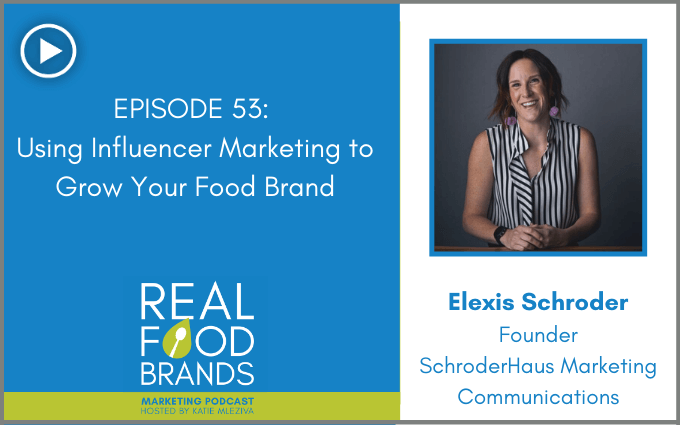
Today on the Real Food Brands Podcast, host and Brand Strategist Katie Mleziva gets a chance to catch up with Elexis Schroder, Founder of SchroderHaus, a Marketing Communications firm based in Denver, Colorado. In this episode, we talk about how to create an influencer marketing strategy that works with your brand’s goals and budgets — and the keys to making it work for you no matter what size of brand you are leading.
Why Influencer Marketing Is Such a Big Deal
Elexis starts by explaining just how much things have changed in the years since she worked in marketing at the agency FleishmanHillard in New York. We’ve moved to a 24-hour news cycle, and people spend much less time because they consume so much more content in a much wider variety of forms. Social media influencers are big part of that shift, in part because they’re remarkably effective. “Specific to food, 35% of millennials made a food or beverage purchase impacted by an influencer,” Elexis says.
What that ultimately translates to is this idea of brand building through relationships. “Influencer programs should vary depending on the life stage of the company, budget availability, and what the goals are for a program,” Elexis says. A startup brand might simply want to get samples to local or regional influencers where you’ve already got retail distribution, whereas a larger brand that has a dedicated social media team and national distribution is going to be using influencers as part of a larger integrated marketing plan.
Identifying the Right Influencers for Your Brand
When it comes to identifying the right partner for your brand, it’s going to depend on your goals. You want to look at both the track record an influencer has with hitting the goals you have, and how their audience actually behaves. “What’s most important first is looking back at influencers who are already talking about your brand, and seeing if they might be a fit for your program,” Elexis says. Those people are already proven ambassadors who are showing an affinity towards what you’re offering, and they’re hungry to share more about you.”
To find the right influencers for you, you can rely on an agency, use a tool or platform to help you in your search, or work backward by looking at who’s worked with like-minded brands or on campaigns similar to what you have in mind. Again, it all comes back to your goals.
Elexis has a lot of great tips about how to reach out to influencers in a genuine way, when to use contracts in your influencer relationships and how to best collaborate to create truly authentic content, so be sure to listen to the full episode to hear the rest of the conversation.
Now, let’s go shake up shopping carts!
In This Episode:
- How marketing has changed with the increase of social media.
- Why influencers should be a key component of your marketing strategy.
- Why influencer marketing is never one-size-fits-all.
- How to identify the right influencers for your brand.
- Why the best influencers are often right under your nose.
- Why it all comes back to your marketing goals.
- How to send samples in a way that is sure to get influencers talking.
- The 5 tips to activating your influencer campaign with success.
Quotes:
“We build and execute programs for that combine the right team of experts and the right tactics so our clients get exactly what they need, when they need it, rather than paying for a bunch of stuff they don’t.” – Elexis Schroder
“Specific to food, 35% of millennials made a food or beverage purchase impacted by an influencer.” – Elexis Schroder
“Influencer programs should vary depending on the life stage of the company, budget availability, and what the goals are for a program.” – Elexis Schroder
“What’s most important is looking back a who’s already talking about your brand first, and seeing if they might be a fit for your program,” Elexis says. Those people are already proven ambassadors who are showing an affinity towards what you’re offering, and they’re hungry to share more about you.” – Elexis Schroder
Resources: