Do you ever feel like you’re starring in your very own David and Goliath story as you try to take on big brands for market share and shelf space?
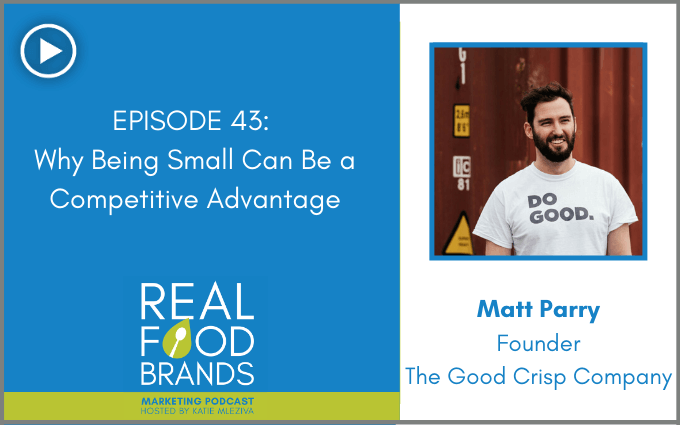
Today on the Real Food Brands Podcast, host and Brand Strategist Katie Mleziva has a conversation with Matt Parry, founder of the Good Crisp Company, the canister chip brand that has replaced Pringles on all Virgin Australia and Tiger flights, is stocked in more than ten thousand supermarkets across the US, and is in the top ten fastest-growing brands in Whole Foods stores.
How an Idea Became a Business
Matt became driven to develop the perfect chip when he was both going through the process of taking a close look at what he was eating and how it was affecting him, and also trying to find snacks for his two young daughters. “I loved canister chips, I liked the portability of the product, I liked the fun of it,” he says, “I thought, ‘There’s got to be a better way, a healthier chip out there,’ so I searched all around the world and I couldn’t really find anything.”
With Matt’s background in Consumer Packaged Goods (CPG), he placed a bet that others would be interested as well. His prior business was importing other people’s brands and launching them in Australia, “so I’d launched hundreds of brands and seen what works, and what doesn’t work,” he says, “it helped us to have an understanding of what we needed, the pricing, and the margins people work on.” At the same time, he knew as a customer what he was looking for: gluten-free, certified non-GMO, no MSG, and using only sustainable oils. “I was able to look at it from both the perspective of the customer as well as the business and brand owner,” he says.
Why the Good Crisp Company can Compete in Both Walmart and Whole Foods
When it comes to competing in a category that is so dominated by one big brand, Matt points out that they don’t just want to go up against Pringles. “Our competitive advantage is our point of difference,” he says, “so it’s not a marketing gimmick, we haven’t just put a healthy green wash on this product, it actually is better for you.” While they have seen significant growth in recent years, Good Crisp Company is still the small guy, so they’re able to appeal to consumers who want to know who’s behind the brand and actually making the food. Matt shares how much they care about the consumer and focus everything they do around them, versus production efficiencies, for example.
As mentioned, the Good Crisp Company is one of the top ten fastest-growing brands in Whole Foods, but they’re also available in Walmart. “Our product really is a broad-spectrum product,” Matt says, “we don’t want to go too niche, we’re not a super-specific diet or ingredient-based product that has a really specific niche tribe.” They’re clear on what decision they want their consumer to make: you want to get your kids a snack, but you want it to be healthy, so trade up to our brand. While the hit rate might be higher at Whole Foods, there are definitely a lot of shoppers at Walmart who are looking for the same thing, so their appeal transcends specific retailers.
The Importance of Networking and Peers
Coming from a different country to build the Good Crisp Company in the US, Matt didn’t have a lot of connections in the industry at first. Even with his experience in CPG, there are big differences, like brokers for example, that are unique to the American market. “I’d go to ExpoWest and put our products on the table,” Matt says, “and then sift through all of those business cards after the show.” Eventually, he was able to add a VP of Sales to the team, which has made a big difference in navigating the broker system.
“Boulder has a great natural product industry,” Matt says, “people are very generous with their expertise and experience, so reaching out to other companies in similar positions or a bit ahead of us and asking for advice, who they use and who they would recommend has been really invaluable.” As brands, we’re often focused on “networking” to find investors and buyers, but it’s the network of peers and co-founders that have made the difference for Matt. It’s important to remember that there are people out there who want to be where you are, so while you’re seeking mentors, also make yourself available to help those along who are a few steps behind you. As they say, a rising tide lifts all ships.
Now, let’s go shake up shopping carts!
In This Episode:
- How Matt’s desire for a healthy snack for his daughters became a fast-growing brand.
- Why Matt was able to look at his brand as both a marketer and a customer.
- When your point of difference can become your competitive advantage.
- The appeal that smaller brands have with customers.
- Why they’re as comfortable in Walmart as they are in Whole Foods.
- How Matt navigated the broker system.
- The importance of peer networking.
- What the Good Crisp Company does on social media and how they work with influencers.
Quotes:
“I was able to look at it from both the perspective of the customer as well as the business and brand owner” – @TheGoodCrispCompany
“Our competitive advantage is our point of difference. So it’s not a marketing gimmick, we haven’t just put a healthy greenwash on this product, it actually is better for you.” – @TheGoodCrispCompany
“Our product really is a broad-spectrum product. We don’t want to go too niche, we’re not a super-specific diet or ingredient-based product that has a really specific niche tribe.” – @TheGoodCrispCompany
“Reaching out to other companies in similar positions or a bit ahead of us and asking for advice, who they use and who they would recommend has been really invaluable.” – @TheGoodCrispCompany
Resources: