People want to feel a sense of belonging. They like to be a part of something. Brands who tell a story that invites people in and offer a solution to a problem (versus just talking about themselves and what they offer) are more memorable, referable and create a sense of loyalty for all involved.
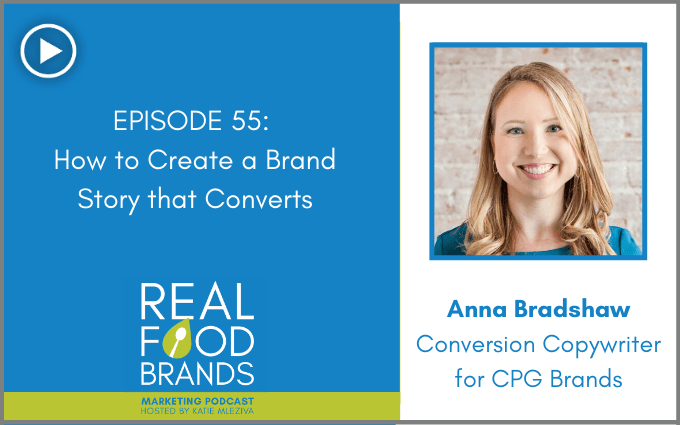
Today on the Real Food Brands Podcast, host and food & bev Brand Strategist Katie Mleziva chats with Anna Bradshaw, a conversion copywriter specializing in brand story and ecommerce marketing for independent CPG brands. In this episode, we talk about how to create a brand story that makes a connection with your consumers and other stakeholders.
We are going to help you figure out how to set up the problem, explain why you’re the solution, and play up the outcome of using your products.
What is Conversion Copywriting?
“Conversion copywriting is focused on that call to action piece—it’s getting people to click ‘buy,’ or whatever the conversion means in the context,” Anna says, “whether it’s clicking subscribe for your email newsletter or putting your item in their cart and carrying it through to check out.” One of the most important things you can do to succeed is solid customer research, which is not just knowing what your ideal audience needs and wants but the specific words they use to describe it.
One of Anna’s main areas of focus is brand story, the way that you talk about your brand to set it apart from others in your category. “When your brand story can build a community and establish a movement around your product, it makes for a much more powerful customer experience,” she says. One way to start thinking about brand story is by way of Donald Miller’s StoryBrand framework. The customer is always the hero of your story, the problem they encounter, the guide (that’s you), the plan and call to action the guide suggests, which helps the hero avoid failure and reach success. This isn’t the only framework, however, and ultimately, Anna suggests finding whatever method works best for you and your brand.
How to Develop Your Brand Story
“When you sit down with a blank page in front of you, it can be really intimidating,” Anna says, “so I recommend just trying to write the individual elements of your story, and that starts with characters. Your customer is the hero of the story—start there.” The villain, of course, is the problem that you’re solving, and that can be anything from convenience to something as simple as brightening your day. You don’t need to overthink the villain, that’s where some people get stuck.
Ultimately, it’s most helpful to focus on the outcome. This is a step many people miss. Not just how solve the problem, but offer what your customer’s life looks like after they’ve discovered your product. “After they’ve discovered your brand of popcorn, how are their movie nights so much more fun,” Anna says, “or after they’ve discovered your healthy snack option, how are their long afternoon meetings more productive because they have more energy because they have your snack?” If you just do problem and then solution it gets you part of the way there, but you need to reinforce why that solution matters in their life.
The Importance of a Clear Brand Story
When it comes to how to make your brand story clear, Anna recommends starting with your website. “From the very first tagline on our homepage all the way through the contact page, you can have elements of your brand story,” she says, “on your packaging you have a really limited character count, but on your website you have unlimited space to explain.” You don’t need to be wordy, but make sure you’re taking the space you need to communicate what your brand values are. Your email marketing is also a great place to get started.
Whether you’ve got one employee or a team, it’s important to make sure they know your brand story because ultimately, that’s why they get out of bed and come into work every day. This is something Katie talks about a lot in terms of the ‘Aligning’ phase of Brand Strategy work (define, align & activate). You want to make sure that every decision they make is aligned with your brand story. At the end of the day, you need to prioritize clarity. “If you’re having trouble communicating your brand story in a way that is clear to consumers, it’s better to have less personality and clearer messages than a really fun, energetic brand personality but a confusing message,” Anna says. Clarity wins when it comes to conversion.
Listen to full episode for more, including what Anna thinks are the biggest traps with brand story, how to remain customer-focused, and her three myths about brand story.
Now, let’s go shake up shopping carts!
In This Episode:
- What is conversion copywriting and how can it help you?
- Why customer research is at the core.
- How to be clear about your brand story.
- When the StoryBrand framework is useful, and when it’s not.
- How to get past common roadblocks.
- Why it’s important to look past solutions and focus on outcomes.
- Where to communicate your brand story.
- How to strike a balance in your customer communications.
Quotes:
“When your brand story can build a community and establish a movement around your product, it makes for a much more powerful customer experience.” –Anna Bradshaw
“When you sit down with a blank page in front of you, it can be really intimidating. I recommend just trying to write the individual elements of your story, and that starts with characters. Your customer is the hero of the story—start there.” – Anna Bradshaw
“From the very first tagline on our homepage all the way through the contact page, you can have elements of your brand story. On your packaging you have a really limited character count, but on your website you have unlimited space to explain.” – Anna Bradshaw
“If you’re having trouble communicating your brand story in a way that is clear to consumers, it’s better to have less personality and clearer messages than a really fun, energetic brand personality but a confusing message.” – Anna Bradshaw
Resources: